


Grinding media is part of the process, not merely a consumable added to a mill. Every collision can transfer a small amount of media material into the product, change particle-size distribution, generate heat, or alter grinding efficiency. The wrong media may therefore create a quality problem long before it looks expensive on a purchasing spreadsheet.
Alumina ceramic grinding media is often selected when a plant wants to reduce iron pickup associated with steel media, maintain product color, or obtain a more chemically stable grinding environment. However, “ceramic” and “high alumina” are not complete specifications. Alumina content, density, microstructure, bead or ball size, roundness, wear rate, fracture behavior, and compatibility with the mill all affect the result.
This guide explains how to specify alumina grinding balls for a real process. It also clarifies what low contamination means, which data to request from a supplier, how to run a useful production trial, and how rotating media should be evaluated together with stationary ceramic wear-resistant parts in the rest of the material-handling system.
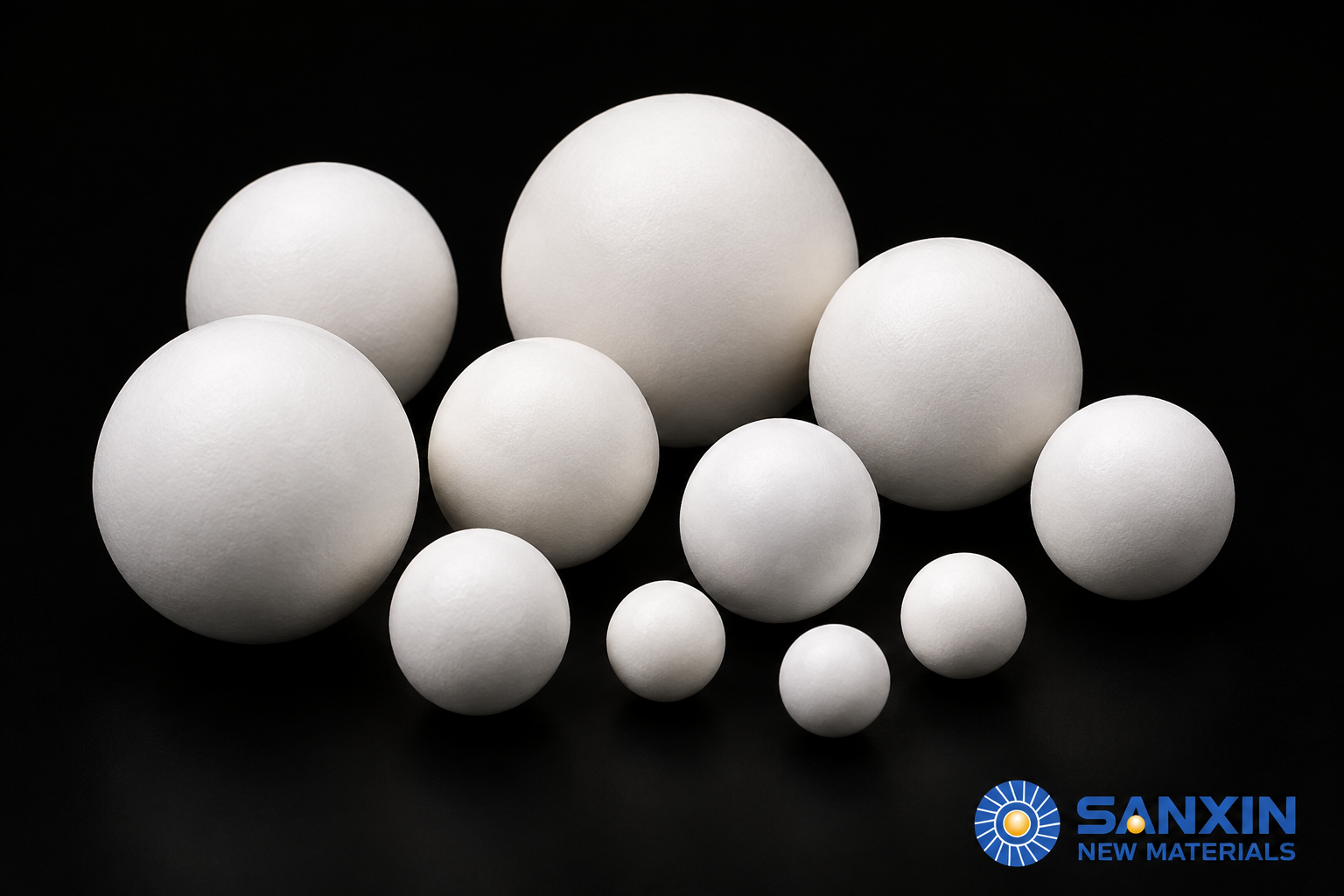
No grinding medium is universally contamination-free. A media body wears during operation, even when the mass loss is very small. Alumina media can reduce ferrous contamination compared with carbon-steel or many alloy-steel balls, but wear debris from alumina media can still add aluminum- and oxygen-containing material, along with trace constituents from the ceramic formulation. Whether that transfer is acceptable depends on the product specification.
The correct purchasing question is not “Does this media create zero contamination?” It is “Which elements may be introduced, at what measured rate under our process conditions, and what is the maximum transfer our product can tolerate?” A white pigment producer may focus on iron and color. A battery-material plant may control several metallic impurities at much lower limits. A ceramic body containing alumina already may tolerate alumina wear more readily than a formulation in which aluminum is restricted.
Low contamination is therefore a relative and application-specific target. Define the controlled elements, their starting concentrations, the maximum permitted increase, the analytical method, the sampling point, and the production interval. Then compare media candidates with the same mill, feed, liquid, energy input, and test duration. A generic statement on a brochure cannot replace that comparison.
Media-related contamination can arise through abrasion, impact chipping, breakage, chemical interaction, and residues left from manufacture or previous service. These mechanisms should be separated because each requires a different corrective action.
Abrasion gradually removes microscopic material from the surface. It is influenced by media hardness, feed abrasiveness, mill speed, slurry solids, viscosity, residence time, temperature, and the surface condition of the mill lining. Impact chipping produces larger fragments when media collides with other media, internal hardware, or an unsuitable lining. Catastrophic breakage usually points to excessive impact, hidden defects, poor toughness, incorrect media size, or severe thermal or mechanical shock.
Chemical interaction can matter even when visible wear is low. Process liquids, cleaning agents, pH, temperature, and dissolved species may attack the ceramic phase or its minor constituents. Surface residues can also affect the first batches if new media is placed in service without an agreed cleaning and conditioning procedure.
Contamination is only one quality variable. Media can influence grinding time, particle-size distribution, temperature rise, slurry rheology, color, filtration, and downstream dispersion. A successful media trial must measure the product properties that determine saleable quality, not just the weight of media consumed.
Alumina ceramics combine high hardness, useful wear resistance, electrical insulation, and stability in many industrial environments. Compared with steel media, alumina grinding balls can reduce the direct source of iron-rich wear debris. Their lighter density also changes the collision energy and mill power demand, which may be beneficial or may require process adjustment.
Compared with denser zirconia-based media, alumina may offer a different balance of purchase price, density, wear behavior, and permitted elemental transfer. Zirconia is not automatically better or worse; it may be preferred when high density, small bead size, or toughness is important. Alumina may be preferred when the formulation tolerates alumina transfer and the process benefits from its cost-performance balance. The feed material, mill type, desired fineness, and contamination limits should decide.
Sanxin New Materials supplies multiple grinding media families rather than treating one composition as universal. Buyers should request the grade-specific data sheet and sample that correspond to the quotation. Product names alone are not a reliable basis for comparing two manufacturers.
Media selection begins with a complete duty description. Record the mill type: ball mill, attritor, stirred mill, vertical mill, planetary mill, or another design. Provide the chamber material, internal dimensions, working volume, drive power, normal speed, critical-speed percentage when relevant, agitator design, screen or separator opening, and existing lining.
Describe the feed with more than a product name. Include the starting particle-size distribution, target distribution, maximum particle size, solids content, bulk or slurry density, hardness or abrasiveness, particle shape, moisture, viscosity, temperature, pH, solvent, and any component that attacks ceramic or polymeric parts. State whether grinding is dry or wet and whether the process is batch or continuous.
Production goals should include throughput, residence time, acceptable temperature rise, required color, controlled impurities, cleaning frequency, and planned campaign length. Also document the current media: composition, size mix, charge mass or volume, operating hours, top-up rate, breakage, and measured product contamination. Without this baseline, a trial can show a change but not whether it is an improvement.
Alumina percentage is an important grade marker, but it does not disclose the full formulation. Minor oxides and processing aids affect sintering, density, color, chemical behavior, and the elements that may enter the product. Ask for the declared alumina content, major minor constituents, and controlled trace elements relevant to your application.
Do not assume that the highest alumina percentage always produces the lowest total cost. A higher-purity grade may be justified for an electronic material or high-value white powder, while a less costly grade may be suitable for coarse mineral grinding. The best grade is the lowest-risk grade that meets the product, process, and economic requirements demonstrated by testing.
Media density influences the energy delivered during motion, but performance is not proportional to density alone. Mill speed, bead diameter, agitator geometry, charge level, viscosity, and feed behavior determine how energy is transferred. A denser medium may improve breakage in one mill and create excess heat, wear, or screen load in another.
When replacing steel with alumina, do not substitute only by mass. The volume occupied by the charge will differ because the densities differ. The mill supplier’s recommended filling method, free volume, and power limits should control the initial setup. Record both charge mass and calculated or measured charge volume.
Large balls provide stronger individual impacts and are normally associated with coarser feed or conventional ball milling. Smaller media creates more contact points and can support finer grinding, particularly in stirred equipment, but it must remain large enough for the separator or screen and appropriate for the feed size.
One common failure is selecting small media before the feed has been adequately pre-ground. The balls then lack sufficient impact energy to break the largest particles, circulation becomes inefficient, and grinding time increases. Another failure is using oversized media for a fine dispersion, which reduces the number of contacts and may cause unnecessary impact on the mill.
Ask the mill manufacturer or process engineer for the permitted media range. Run trials with controlled size distributions rather than a random mixture. If a graded charge is used, define the starting ratio and the top-up rule so production can reproduce the test.
A wear number has little meaning unless the method is stated. Laboratory abrasion tests, jar-mill tests, supplier internal methods, and full-scale production measurements can produce different results. Request the test duration, mill type, speed, slurry or feed, media size, temperature, calculation basis, and number of repetitions.
For plant comparison, weigh a representative, cleaned, and dried media sample before and after a controlled run, or track the entire charge and top-up mass over a defined campaign. Relate loss to tonnes of product, operating hours, or energy consumed. At the same time, analyze the product for the relevant elements. A low mass-loss result is valuable only if product quality and grinding performance also meet target.
Consistent roundness supports predictable movement, packing, and contact. Large dimensional variation can change the effective size distribution before the process begins. Surface pits, seams, cracks, or rough areas may act as early wear sites and can trap material during product changeover.
Inspection should include a documented sampling plan. Measure diameter and roundness on a statistically useful sample, not one ideal ball. Examine surfaces under suitable lighting and, for critical duties, use magnification. Agree on how chipped, cracked, fused, or discolored pieces will be classified.
Two media products with similar chemistry and density can behave differently because forming, drying, and sintering produce different grain structures and defect populations. Excessive pores, density gradients, or hidden cracks may lead to chipping or breakage under cyclic impact.
Buyers may request density, water absorption or apparent porosity, hardness, crushing or compressive data where applicable, and microstructural evidence for critical projects. Test results must identify the exact grade and batch. More importantly, a production trial should track broken pieces and classify the failure mode. A media ball that remains intact but wears steadily is a different problem from one that fractures into damaging fragments.
Review the complete process chemistry, including cleaning. A medium may perform well in a neutral aqueous slurry but respond differently to strong acid, strong alkali, fluoride-containing chemistry, hot solvent, or repeated thermal cycles. The ceramic body, mill lining, seals, screens, adhesives, and any composite wear-resistant ceramic parts must all be compatible.
Provide normal and maximum temperature, heating rate, cooling method, pH range, solvent identity, cleaning chemicals, and exposure duration. Do not use a maximum material temperature as proof that the assembled mill system can operate at that temperature. Thermal expansion differences and attachment materials may set a lower system limit.
Stable production is often more valuable than one unusually good sample. Ask how the supplier controls raw materials, forming, sintering, sorting, cleaning, and packaging. Require a batch or lot identifier, inspection record, and certificate of analysis when appropriate. The delivery sample, trial batch, and production order should be traceable to the quoted grade.
Define change notification for important parameters. If formulation, raw-material source, firing route, size tolerance, or manufacturing site changes, the process may require requalification. This is especially important where impurity limits or color are tight.
Grinding media never operates alone. It contacts the mill lining, agitator, discs, pins, separator, screen, and product. A low-contamination media choice can be undermined by an exposed steel bolt, worn metal liner, damaged screen, or unsuitable repair material.
Map every product-contact surface and identify its material. Inspect the highest-energy zones and transitions. When abrasive powder leaves the mill, review cyclones, bends, chutes, valves, and conveying pipes as well. Sanxin’s alumina ceramic liners and wear-resistant parts are intended for stationary wear protection; they should be selected by impact, sliding abrasion, temperature, chemistry, geometry, and attachment method.
Do not automatically combine the hardest available media with the hardest available lining. The interaction may increase impact stress or create an unfavorable wear couple. Mill suppliers often specify permitted media and lining combinations. Follow those limits and qualify any change with a controlled test.
A useful trial changes one main variable at a time and preserves enough data to explain the outcome. Begin with a written baseline covering feed lot, mill settings, existing media, charge level, throughput, particle-size result, temperature, energy, media consumption, product chemistry, and rejection rate.
Clean the mill and new media according to an agreed procedure. If conditioning batches are required, identify them and do not mix their results with normal production. Record the starting media mass, size distribution, batch number, and photographs. Confirm that screens and separators can retain the selected size.
During the trial, keep feed and operating conditions as stable as practical. Take samples at defined times rather than only at the end. Measure particle-size distribution, product chemistry, color or whiteness when relevant, viscosity or rheology, temperature, throughput, energy per tonne, and any other critical quality attribute.
At completion, recover a representative media sample. Clean and dry it consistently before weighing. Count or weigh broken pieces, inspect surface change, and compare the size distribution with the starting sample. Note deposits, discoloration, abnormal noise, screen loading, or changes in mill power.
Repeatability matters. A single short trial can be influenced by feed variation or initial conditioning. For a high-value qualification, run enough cycles or campaigns to separate normal scatter from a durable improvement. State acceptance criteria before the test; do not redefine success after seeing the results.
Media purchase price is visible, but the largest cost can be poor yield, long grinding time, off-spec contamination, unplanned cleaning, or mill downtime. Compare alternatives using the same production basis.
A practical cost model may include media top-up per tonne of saleable product, energy per tonne, throughput, labor for charging and screening, cleaning time, disposal, liner and component wear, rejected product, and lost production during downtime. Add freight, packaging, inventory, and the cost of requalification if supply changes.
Avoid unsupported service-life multipliers. If a supplier says one grade lasts several times longer, ask for the operating conditions and test basis. Your trial result is more useful than a claim from a different mill, feed, or loading condition.
Consider the value of contamination control separately. A slightly more expensive medium may be economical if it prevents product downgrading or reduces purification. Conversely, a premium high-purity ball is unnecessary if the product specification and process do not benefit from it.
Alumina media is widely considered where ceramic formulations already contain alumina-compatible constituents and iron pickup can affect color or firing behavior. Selection should account for feed hardness, desired residue, slurry viscosity, glaze color, and the mill lining. Test fired properties as well as the wet-milled slurry.
Calcium carbonate, kaolin, quartz-containing materials, and other mineral products vary greatly in abrasiveness and target fineness. Measure media consumption per tonne and check brightness or controlled elements. Coarse feeds may require staged grinding or a larger starting media size before fine milling.
Color, dispersion, viscosity, and particle-size distribution may be more important than nominal throughput. A small amount of dark contamination can be unacceptable in a bright or transparent product. Validate the complete formulation, including solvent and additives, and check whether media residues affect downstream filtration or film properties.
These applications can have strict impurity requirements. The phrase “non-metallic media” is not sufficient because ceramic wear still transfers elements. Define the impurity panel and analytical detection limits, qualify cleaning, control lot traceability, and test the final functional material. For especially sensitive formulations, another ceramic composition may be more appropriate than alumina.
Material performance alone does not establish regulatory suitability. Buyers must review the exact product-contact requirements, declarations, migration or extractables evidence, hygiene design, cleaning validation, and local regulations. Do not infer food or pharmaceutical compliance from ceramic chemistry or color.
For an engineering purchase, request a technical data sheet for the exact grade, a certificate of analysis or conformance for the supplied lot when required, dimensional tolerance, density and wear-test method, and a statement of controlled chemical constituents. Add packaging, cleanliness, storage, and traceability requirements to the purchase specification.
For critical service, request representative samples and agree on independent testing. Make sure the laboratory method can distinguish media-derived elements from the feed, water, additives, lining, and sampling tools. Retain baseline and post-trial samples for investigation.
The drawing or data sheet should identify media size, grade, nominal composition, and acceptance criteria. Marketing terms such as “super,” “premium,” or “ultra-wear-resistant” are not measurable requirements. Convert them into numbers with methods and tolerances.
Include the following information in a request for quotation:
mill type, manufacturer, model, chamber volume, power, speed, and lining material;
dry or wet process, batch or continuous operation, and normal operating hours;
feed name, chemistry, initial particle-size distribution, hardness, and maximum particle size;
liquid, solids percentage, density, viscosity, pH, temperature, and cleaning chemicals;
target particle-size distribution, throughput, color, and controlled impurity limits;
current media composition, sizes, charge level, consumption, breakage, and problems;
separator or screen opening and the mill maker’s permitted media range;
requested alumina grade, size or graded charge, quantity, packaging, and delivery schedule;
required documents, sampling plan, acceptance tests, and lot traceability;
trial quantity and the production-scale acceptance criteria.
If the same project includes downstream abrasion, provide drawings and service data for the ceramic wear-resistant part portfolio. Keeping media and fixed wear protection in one technical review helps identify contamination or wear sources outside the mill.
The first mistake is specifying only alumina percentage. Chemistry matters, but density, microstructure, size tolerance, surface finish, wear, and fracture behavior also determine performance. The second is using “zero contamination” as an acceptance criterion without naming elements or detection limits.
The third mistake is replacing media kilogram for kilogram without recalculating charge volume and mill load. The fourth is selecting bead size from the target particle size alone while ignoring feed top size, separator opening, and mill design. The fifth is comparing supplier wear values measured with different methods.
Other frequent errors include skipping mill cleaning, mixing old and new media during a trial, failing to analyze the baseline product, ignoring exposed metal internals, and judging the trial only by grinding time. A faster grind that creates off-spec chemistry or excessive temperature is not an improvement.
They can reduce iron-rich wear associated with steel media because the grinding body is ceramic, but they do not make the process universally contamination-free. Alumina wear can introduce aluminum-containing material and trace constituents. Define and test the impurity limits relevant to the product.
No. Higher purity may help some high-value or impurity-sensitive applications, but total performance also depends on density, microstructure, toughness, size, mill conditions, and cost. Select the grade through comparable data and trials.
Not by a simple mass-for-mass substitution. Different density changes charge volume, power draw, and collision behavior. Confirm the mill’s permitted media, calculate filling by volume, and trial operating settings safely.
Use the same method and conditions. Record starting and ending media mass, product tonnes or hours, energy, breakage, particle-size result, and product chemistry. The test method and cleaning procedure must be documented.
Provide the mill design, lining, feed and target sizes, process chemistry, temperature, solids or viscosity, throughput, current media, impurity limits, and trial acceptance criteria. Photographs and recent operating data are helpful.
Yes. Product-contact bends, chutes, pipes, valves, and separators can add contamination or fail after the mill is improved. Review the complete flow path and select stationary ceramic wear protection separately for its actual duty.
Alumina ceramic grinding media can be a practical route to lower ferrous contamination and controlled industrial grinding, but it must be specified as an engineered process component. Define the acceptable impurity transfer, document the mill and feed, compare grade-specific chemistry and physical data, select a compatible size, and verify performance in a controlled trial.
Sanxin New Materials Co., Ltd. can review operating information for alumina grinding balls, alternative ceramic media, and fixed wear protection. Send the mill type, feed and target particle sizes, process chemistry, current media consumption, controlled impurities, and intended trial scale. The resulting recommendation should be confirmed by the final quotation, technical data sheet, and your production test rather than by a universal performance claim.

Soumettez votre demande,
Nous vous contacterons dès que possible.

Sanxin New Materials Co., Ltd. se concentre sur la production et la vente de perles en céramique et des pièces telles que les médias de broyage, perles de dynamitage, bille de roulement, partie de structure, revêtements en céramique résistant à l’usure, nanoparticules Nano poudre


 français
 français
 russe
russe français
 espagnol
 portugais
 arabe
arabe